Journal of Multidisciplinary Dental Research
DOI: 10.38138/JMDR/v12.1.25.34
Volume: 12, Issue: 1, Pages: 5-11
Original Article
Ilma Robo1*, Manola Kelmendi2, Saimir Heta1, Redjona Koci3
1Department of Therapy, Faculty of Dental Medicine, University of Medicine, Tirane, Albania
2Department of Pediatric Surgery, Faculty of Medicine, University of Medicine, Tirana, Albania
3Dental Private Clinic, Faculty of Dental Medicine, University of Medicine, Tirane, Albania
*Corresponding Author
Email: [email protected]
Received Date:27 July 2025, Accepted Date:01 December 2025, Published Date:09 July 2026
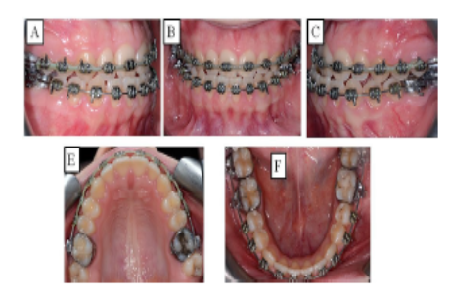
Fixed orthodontic appliances passively affect the health of periodontal tissues by preventing access to good oral hygiene, resulting in accumulation of bacterial plaque. This study has the purpose of finding data about the clinical evaluation of gingival hypertrophy, caused in patients treated with fixed orthodontic appliances in the oral cavity. At 34 patients with fixed orthodontic appliances, clinical data about vertical growth index and horizontal growth index of papillary gingiva, in Ramfjord teeth, were recorded. Data about the index of gingival hemorrhage were also recorded. Statistical analysis of the data was performed using the McNemar test to compare the frequency of correct responses, compared to the frequency of incorrect responses against specific items included in the questionnaire prepared for use in this study. Fisher's exact test was used to make the comparison in a 2x2 contingency table. Vertical index of hypertrophy (IV) in tooth 11 is more reduced than in tooth 31. Horizontal index of hypertrophy (HI) is in the same values in both teeth. PBI-index has higher values in tooth 31. For teeth 14 and 34, IV-index is higher in tooth 14, and IH-index for the same PBI index. For teeth 26-46: IV-index and IH-index are higher in 26 than in 46 with the same difference range of 0.4. The PBI is higher at 46 than at tooth 26 with a value difference of 0.3. According to age groups IV, the highest values of I are in the post-adolescent age of 17-21 years, while IH is in the adolescent age of 12-16 years. The highest IH-index is in adolescence and the most reduced in adulthood. PBI regardless of gender has the same values, where in men it reaches the highest values in adulthood, while in women it reaches the highest value in adolescence. The mandibular incisor is more prone to coronal coverage from orthodontic appliance-induced gingival hypertrophy than the maxillary incisor. Gingival hypetrophy caused by the insufficient plaque removal at orthodontic appliance in 14 has a more obvious cubic shape than in 34.
Keywords: Fixed orthodontic appliances, PBI-index, IV-index, IH-index, Gingival hypertrophy
1. Eid HA, Assiri HA, Kandyala R, Togoo RA, Turakhia VS. Gingival enlargement in different age groups during fixed Orthodontic treatment. Journal of International Oral Health. 2014 Feb;6(1):1-4. Epub 2014 Feb 26. https://pmc.ncbi.nlm.nih.gov/articles/PMC3959129/
2. Zanatta FB, Ardenghi TM, Antoniazzi RP, Pinto TM, Rösing CK. Association between gingivitis and anterior gingival enlargement in subjects undergoing fixed orthodontic treatment. Dental Press Journal of Orthodontics. 2014; 19 (3). Available from: https://doi.org/10.1590/2176-9451.19.3.059-066.oar
3. Almansob YA, Alhammadi MS, Luo XJ, Alhajj MN, Zhou L, Almansoub HA, et al. Comprehensive evaluation of factors that induce gingival enlargement during orthodontic treatment: A cross-sectional comparative study. Nigerian Journal of Clinical Practice. 2021; 24 (11). Available from: https://doi.org/10.4103/njcp.njcp_69_21
4. Vincent-Bugnas S, Borsa L, Gruss A, Lupi L. Prioritization of predisposing factors of gingival hyperplasia during orthodontic treatment: the role of amount of biofilm. BMC Oral Health. 2021; 21 (1). Available from: https://doi.org/10.1186/s12903-021-01433-2
5. Hosadurga R, Nabeel Althaf MS, Hegde S, Rajesh KS, Arun Kumar MS. Influence of sex hormone levels on gingival enlargement in adolescent patients undergoing fixed orthodontic therapy: A pilot study. Contemporary Clinical Dentistry. 2016; 7 (4). Available from: https://doi.org/10.4103/0976-237x.194099
6. Baeshen HA, Alsulaimani FF, Awadh W, Ageeli MA, Abullais SS, Alqahtani NA, et al. Comparative assessment of the cell-surface antigens and gene expression profiles of the gingival tissue biomarkers in subjects with fixed functional and removable functional orthodontic appliances. Saudi Journal of Biological Sciences. 2022; 29 (3). Available from: https://doi.org/10.1016/j.sjbs.2021.10.047
7. Pretti H, Barbosa GL, Lages EM, Gala-García A, Magalhães CS, Moreira AN. Effect of chlorhexidine varnish on gingival growth in orthodontic patients: a randomized prospective split-mouth study. Dental Press Journal of Orthodontics. 2015; 20 (5). Available from: https://doi.org/10.1590/2177-6709.20.5.066-071.oar
8. To TN, Rabie AB, Wong RW, McGrath CP. The adjunct effectiveness of diode laser gingivectomy in maintaining periodontal health during orthodontic treatment. The Angle Orthodontist. 2013; 83 (1). Available from: https://doi.org/10.2319/012612-66.1
9. Drăghici EC, CrăiŢoiu Ş, Mercut V, Scrieciu M, Popescu SM, Diaconu OA, et al. Local cause of gingival overgrowth. Clinical and histological study. Romanian Journal of Morphology and Embryology. 2016;57(2):427-35. https://pubmed.ncbi.nlm.nih.gov/27516015/
10. Li N, Wang W, Sun Y, Wang H, Wang T. Seven-year follow-up of a patient with hereditary gingival fibromatosis treated with a multidisciplinary approach: case report. BMC Oral Health. 2021; 21 (1). Available from: https://doi.org/10.1186/s12903-021-01830-7
11. Rauten AM, Silosi I, Stratul SI, Foia L, Camen A, Toma V, et al. Expression of Pentraxin 3 and Thrombospondin 1 in Gingival Crevicular Fluid during Wound Healing after Gingivectomy in Postorthodontic Patients. Journal of Immunology Research. 2016; 2016 Available from: https://doi.org/10.1155/2016/4072543
12. Monea M, Moldovan C. Rare Root Morphology of a Maxillary Central Incisor Associated With Gingival Hyperplasia. Medicine. 2016; 95 (18). Available from: https://doi.org/10.1097/md.0000000000003617
13. Zanatta FB, Ardenghi TM, Antoniazzi RP, Pinto TM, Rösing CK. Association between gingivitis and anterior gingival enlargement in subjects undergoing fixed orthodontic treatment. Dental Press Journal of Orthodontics. 2014; 19 (3). Available from: https://doi.org/10.1590/2176-9451.19.3.059-066.oar
14. Gong Y, Lu J, Ding X. Clinical, microbiologic, and immunologic factors of orthodontic treatment-induced gingival enlargement. American Journal of Orthodontics and Dentofacial Orthopedics. 2011; 140 (1). Available from: https://doi.org/10.1016/j.ajodo.2010.02.033
15. Giannopoulou C, Mombelli A, Tsinidou K, Vasdekis V, Kamma J. Detection of gingival crevicular fluid cytokines in children and adolescents with and without fixed orthodontic appliances. Acta Odontologica Scandinavica. 2008; 66 (3). Available from: https://doi.org/10.1080/00016350802123126
16. Paschos E, Limbach M, Teichmann M, Huth KC, Folwaczny M, Hickel R, et al. Orthodontic Attachments and Chlorhexidine-Containing Varnish Effects on Gingival Health. The Angle Orthodontist. 2008; 78 (5). Available from: https://doi.org/10.2319/090707-422.1
17. Zanatta FB, Ardenghi TM, Antoniazzi RP, Pinto TM, Rösing CK. Association between gingival bleeding and gingival enlargement and oral health-related quality of life (OHRQoL) of subjects under fixed orthodontic treatment: a cross-sectional study. BMC Oral Health. 2012; 12 (1). Available from: https://doi.org/10.1186/1472-6831-12-53
18. Kouraki E, Bissada NF, Palomo JM, Ficara AJ. Gingival enlargement and resolution during and after orthodontic treatment. New York State Dental Journal.2005 Jun-Jul;71(4):34-7. https://pubmed.ncbi.nlm.nih.gov/16146305/
19. Farhadian N, Bidgoli M, Jafari F, Mahmoudzadeh M, Yaghobi M, Miresmaeili A. Comparison of Electric Toothbrush, Persica and Chlorhexidine Mouthwashes on Reduction of Gingival Enlargement in Orthodontic Patients: A Randomised Clinical Trial. Oral Health and Preventive Dentistry. 2015; 13 (4). Available from: https://doi.org/10.3290/j.ohpd.a33443
20. Vincent-Bugnas S, Borsa L, Gruss A, Lupi L. Prioritization of predisposing factors of gingival hyperplasia during orthodontic treatment: the role of amount of biofilm. BMC Oral Health. 2021; 21 (1). Available from: https://doi.org/10.1186/s12903-021-01433-2
21. Herrera D, Escudero N, Pérez L, Otheo M, Cañete-Sánchez E, Pérez T, et al. Clinical and microbiological effects of the use of a cetylpyridinium chloride dentifrice and mouth rinse in orthodontic patients: a 3-month randomized clinical trial. European Journal of Orthodontics. 2018; 40 (5). Available from: https://doi.org/10.1093/ejo/cjx096
22. Miranda J, Brunet L, Roset P, Farré M, Mendieta C. Reliability of two measurement indices for gingival enlargement. Journal of Periodontal Research. 2012; 47 (6). Available from: https://doi.org/10.1111/j.1600-0765.2012.01495.x
23. Pazzini CA, Júnior GO, Marques LS, Pereira CV, Pereira LJ. Prevalence of Nickel Allergy and Longitudinal Evaluation of Periodontal Abnormalities in Orthodontic Allergic Patients. The Angle Orthodontist. 2009; 79 (5). Available from: https://doi.org/10.2319/081408-430.1
24. Hosadurga R, Nabeel Althaf MS, Hegde S, Rajesh KS, Arun Kumar MS. Influence of sex hormone levels on gingival enlargement in adolescent patients undergoing fixed orthodontic therapy: A pilot study. Contemporary Clinical Dentistry. 2016; 7 (4). Available from: https://doi.org/10.4103/0976-237x.194099
25. Sheehy EC, Roberts GJ, Beighton D, O'Brien G. Oral health in children undergoing liver transplantation. International Journal of Paediatric Dentistry. 2000; 10 (2). Available from: https://doi.org/10.1046/j.1365-263x.2000.00179.x
26. Renkema AA, Dusseldorp JK, Middel B, Ren Y. Zwelling van de gingiva bij orthodontische behandeling met volledig vaste apparatuur. Nederlands Tijdschrift voor Tandheelkunde. 2010; 117 (10). Available from: https://doi.org/10.5177/ntvt.2010.10.10103
27. Guare Rde O, Ciampioni AL. Prevalence of periodontal disease in the primary dentition of children with cerebral palsy. Journal of dentistry for children (Chic). 2004 Jan-Apr;71(1):27-32. https://pubmed.ncbi.nlm.nih.gov/15272652/
28. Corbacho de Melo MM, Cardoso MG, Faber J, Sobral A. Risk factors for periodontal changes in adult patients with banded second molars during orthodontic treatment. The Angle Orthodontist. 2012; 82 (2). Available from: https://doi.org/10.2319/030911-172.1
29. van Gastel J, Quirynen M, Teughels W, Coucke W, Carels C. Influence of bracket design on microbial and periodontal parameters in vivo. Journal of Clinical Periodontology. 2007; 34 (5). Available from: https://doi.org/10.1111/j.1600-051x.2007.01070.x
30. Kloehn JS, Pfeifer JS. The effect of orthodontic treatment on the periodontium. Angle Orthodontist. 1974; 44 (2). Available from: https://doi.org/10.1043/0003-3219(1974)044%3C0127:teooto%3E2.0.co;2
© 2026 Published by International Dental Educationists’ Association (IDEA). This is an open-access article under the CC BY license (https://creativecommons.org/licenses/by/4.0/)
Subscribe now for latest articles, news.