• P-ISSN 2277-3525 E-ISSN 2582-7901

Journal of Multidisciplinary
Dental Research

Article

Journal of Multidisciplinary Dental Research

Volume: 8, Issue: 1, Pages: 33-37

Case Report

Management of Feeding Problems in Infants with Cleft Palate and Review on Pierre-Robin Syndrome

Received Date:17 October 2022, Accepted Date:12 April 2022, Published Date:08 July 2022

Abstract

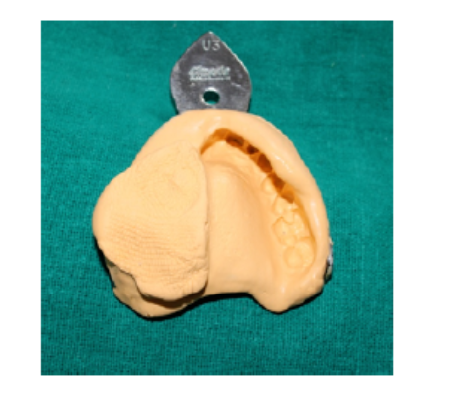
Pierre Robin syndrome is a congenital disorder with triad of features micrognathia, glossoptosis which result in airway obstruction and feeding difficulties and cleft palate. Cleft palate is the most common congenital anomalies of craniofacial region seen in Pierre-Robin syndrome. Infants with cleft palate have to face various problems. Difficulty in feeding is the most common problem faced by cleft palate neonates that made them difficult to maintain adequate nutrition, result in failure to thrive. There are many methods given in literature to overcome this problem including special type of nursing bottles. In this case report, fabrication of feeding plate to obturate the defect in palate and its use in managing feeding problem is described.

Keywords: ­Cleft palate, Feeding plate, Pierre­Robin Syndrome

References

  1. Chandna P, Adlakha VK, Singh N. Feeding obturator appliance for an infant with cleft lip and palate. Journal of Indian Society of Pedodontics and Preventive Dentistry. 2011;29(1):71–73. Available from: https://doi.org/10.4103/0970-4388.79950
  2. Retnakumari N, Divya S, Meenakumari S, Ajith PS. Nasoalveolar molding treatment in presurgical infant orthopedics in cleft lip and cleft palate patients. Archives of Medicine and Health Sciences. 2014;2(1):36–47. Available from: https://doi.org/10.4103/2321-4848.133804
  3. Lakhanpal M, Gupta N, Rao NC, Vashisth S. Genetics of Cleft Lip and Palate - Is it still patchy? . JSM Dentistry. 2014;2:1–4. Available from: http://www.jscimedcentral.com/Dentistry/dentistry-2-1030.pdf
  4. Badwal D, Mabry K, Frassinelli JD. Impact of cleft lip and/or palate on nutritional health and oral-motor development. The Dental Clinics of North America. 2003;47:305–317. Available from: https://doi.org/10.1016/s0011-8532(02)00107-6
  5. Rathee M, Hooda A, Tamarkar A, Yadav S. Role of Feeding Plate in Cleft Palate: Case Report and Review of Literature. The Internet Journal of Otorhinolaryngology. 2009;12(1):1–6.
  6. Erkan M, Karaçay Ş, Atay A, Günay Y. A Modified Feeding Plate for a Newborn with Cleft Palate. The Cleft Palate-Craniofacial Journal. 2013;50(1):109–112. Available from: https://doi.org/10.1597/11-059
  7. Sommerlad B. Cleft palate. In: BG, EE, JP., eds. Plastic Surgery Indications and Practice. (Vol. 22, pp. 508-509) Philadelphia, PA. Saunders Elsevier. 2009.
  8. Mackay DR. Controversies in the Diagnosis and Management of the Robin Sequence. Journal of Craniofacial Surgery. 2011;22(2):415–420. Available from: https://doi.org/10.1097/scs.0b013e3182074799
  9. Printzlau A, Andersen MD. Pierre Robin Sequence in Denmark: A Retrospective Population-Based Epidemiological Study. The Cleft Palate-Craniofacial Journal. 2004;41(1):47–52.
  10. Shprintzen RJ. The implications of the diagnosis of Robin sequence. Cleft Palate Craniofac J. 1992;29(3):205–209. Available from: https://doi.org/10.1597/1545-1569_1992_029_0205_tiotdo_2.3.co_2
  11. Marcellus L. The infant with Pierre Robin sequence: Review and implications for nursing practice. Journal of Pediatric Nursing. 2001;16(1):23–34. Available from: https://doi.org/10.1053/jpdn.2001.20550
  12. Marques IL, Monteiro LCS, Souza LD, Bettiol H, Sassaki CH, Costa RDA. Gastroesophageal Reflux in Severe Cases of Robin Sequence Treated with Nasopharyngeal Intubation. The Cleft Palate-Craniofacial Journal. 2009;46(4):448–453. Available from: https://doi.org/10.1597/08-120.1
  13. Hunt JA, Hobar PC, . Common craniofacial anomalies: the facial dysostoses. Plast Reconstr Surg. 2002;110(7):1714–1725. Available from: https://doi.org/10.1097/01.prs.0000033869.10382.91
  14. Chang AB, Masters IB, Williams GR, Harris M, O'neil MC. A modified nasopharyngeal tube to relieve high upper airway obstruction. Pediatric Pulmonology. 2000;29(4):299–306.
  15. Anderson KD, Cole A, Chuo CB, Slator R. Home Management of Upper Airway Obstruction in Pierre Robin Sequence Using a Nasopharyngeal Airway. The Cleft Palate-Craniofacial Journal. 2007;44(3):269–273.
  16. GFR, Murthy AS, Brie RAL, JBM. The GILLS score: part I.Patient selection for tongue-lip adhesion in Robin sequence. Plast Reconstr Surg. 2011;128(1):243–251.
  17. Boston M, Rutter MJ. Current airway management in craniofacial anomalies. Current Opinion in Otolaryngology & Head and Neck Surgery. 2003;11(6):428–432. Available from: https://doi.org/10.1097/00020840-200312000-00004
  18. Silpa B, Mahesh P, Rao PS, Sahitha K. Feeding Plate: A Boon to Cleft Palate Patients: A Case Report. Sch. J. Dent. Sci. 2016;3(5):129–132.

COPYRIGHT

© 2022 Published by International Dental Educationists’ Association (IDEA). This is an open-access article under the CC BY license (https://creativecommons.org/licenses/by/4.0/)

DON'T MISS OUT!

Subscribe now for latest articles, news.